Tables that tell the truth:
cleaning without rewriting the geology
Session 5 · Fri Oct 9 · Book sections 2.3–2.4
🧮
Today’s question
Cleaning changes your data before any model ever sees it.
Which of your table’s oddities are damage — and which are the science?
Reading: 2.3 Pandas · 2.4 DataFrame preparation
This lecture in the literature
📖 The playbook: whether missing data can be ignored depends on why they are missing — the origin of MCAR / MAR / MNAR.
Rubin, D. B. (1976). Inference and missing data. Biometrika, 63, 581–592.
✗ A spreadsheet’s excluded rows propped up a global austerity argument — reanalysis of the same table reversed the headline result.
Herndon, T., Ash, M., & Pollin, R. (2014). Does high public debt consistently stifle economic growth? A critique of Reinhart and Rogoff. Cambridge Journal of Economics, 38, 257–279.
✓ Doing it right: substituting values at the detection limit fabricates data — model the censoring instead.
Helsel, D. R. (2006). Fabricating data: How substituting values for nondetects can ruin results, and what can be done about it. Chemosphere, 65, 2434–2439.
Rows dropped from a table have moved national policy. Cleaning decisions are scientific claims.
One library, every table
- A global earthquake catalog: 1,785 events, M ≥ 6.0, depths 0–685 km, with timestamps and place names
- The same verbs every time: read, describe, filter, transform, group, join, map
- Datetime-aware: select by time window, resample by day, roll a moving average
Learn the verbs, not the spellings — your coding agent knows the syntax; you must know what to ask for.
Today’s table: a rock survey with planted truth
10,000 rock samples — 7 major-element oxides, density, magnetic susceptibility, lithology
985 andesites — against 5,525 granites: a 5.6 : 1 class imbalance
Synthetic whole-rock geochemistry (mlgeo_synth): the generator plants the correlations and the pathologies, so every cleaning decision is graded against known truth.
Imbalance is the norm in geoscience labels — remember 985 when a classifier reports 90% accuracy in Chapter 3.
A zero is not one thing
| Column | Zeros in the table | Verdict |
|---|---|---|
| MgO | 1,434 | real — evolved granites have fractionated their magnesium away |
| K2O | 824 | real — same logic, other rock types |
| density | 15 | impossible — no rock has zero density: an instrument’s failure code |
The check: is zero inside the physically possible range of this variable?
“Replace all zeros with missing” would delete 1,432 silica-rich granites — rewriting the geology, not cleaning it.
Censored: present, plausible, and wrong
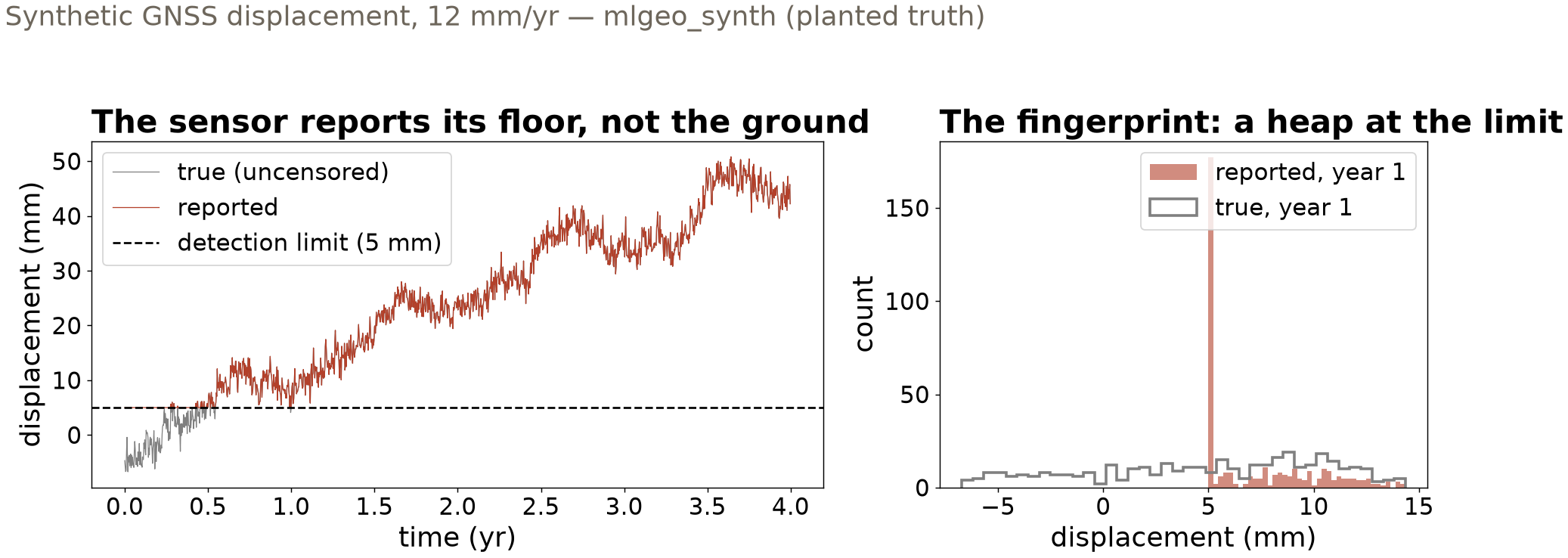
12% of samples sit exactly at the 5 mm floor — yet a missing-data check reports zero problems. Censored data passes every missingness test.
What the floor does to the science
12.44 mm/yr trend fit on the true, uncensored values
11.59 mm/yr trend fit on what the sensor reported
Every low excursion pulled up to the floor: the early mean is too high, the fitted trend too low — biased in a predictable direction. Dropping the censored samples deletes exactly the low values: worse.
Model the censoring, or report the limit in the data card — never substitute and move on.
Why is it missing? The gap can be the data
- The stream gauge drowns in the flood it was built to measure
- The GNSS antenna goes silent under the storm’s snow load
- The field crew skips the location when the road washes out
Missing completely at random (MCAR) — safe to drop. Missing because of the value (MNAR) — dropping deletes your extremes.
Ask what process made the gap. If the answer involves the measurement, the missingness belongs in your data card as data.
The dtype trap
- Cleaning density: replace the impossible zeros with a missing marker — correct
- pandas silently upcast the column: float64 → object (numbers stored as generic objects)
- Every later “numeric columns only” step — correlations, summaries — now drops density without a warning
A column can be numeric in content and non-numeric in dtype. Check dtypes after every cleaning step, not just the first.
Four pathologies, four fingerprints
| Pathology | Fingerprint | Geoscience example | Response |
|---|---|---|---|
| Sentinel value | heap at an impossible value | density = 0 g/cm³ | replace only the impossible ones |
| Censored value | heap at a plausible round value | 5 mm detection floor | model it, or report the limit |
| Informative gap | gaps track events | gauge drowned in the flood | treat the gap as data |
| Dtype drift | numeric content, non-numeric dtype | density after cleaning | check dtypes every step |
Same discipline throughout: diagnose the mechanism first; clean second; write the decision down.
Now run it yourself — open 2.4
pixi run jupyter lab→2.4_dataframes_prep.ipynb- Run the cleaning: count the zeros, replace only the impossible ones, catch the dtype flip and fix it
- Reproduce the censoring bias: 11.59 vs 12.44 mm/yr — then try dropping the censored samples and watch it get worse
- Exercise Q3: what accuracy does “always predict granite” achieve — and what does that imply for evaluating any classifier on this table?
Monday: sampling, resampling & irregular data (2.5–2.6) · HW1 due Mon Oct 12
ESS 469/569 · Machine Learning in the Geosciences · Autumn 2026