Real projects, from this course and the wider GeoSMART community. Read each one through the questions of this chapter: who was the audience for the result, and what was the impact path — who could act on it, and what would they need that the project did or did not yet provide? The gallery is also the best calibration available for scoping your own final project: these were done in ten weeks by groups like yours.
GeoSMART use-case library
The GEO-SMART project maintains a collection of executable JupyterBooks of ML use cases across the geosciences — glaciology, hydrology, seismology, planetary — each a complete workflow from data to evaluation:
- GeoSMART scientific case studies book
- GeoSMART project site — curriculum, use cases, and hackweek materials
These are written for the domain peer audience (7.1’s first column): they assume you want to rerun and adapt the workflow, so the deliverable is the executable book itself.
Course project: Seasonal Ice Velocity Prediction — Claire Jensen (UW)
Time series forecasting of surface ice velocity on Zachariæ Isstrøm, Northeast Greenland. Ice velocity data are satellite-derived estimates from the Greenland Ice Sheet Mapping Project (GrIMP). Three time series were aggregated from different points on the glacier and trained and tested separately, finding different optimal parameters and models for each point. Classic and deep models were compared, including LightGBM, RandomForest, LSTM, CNN, and transformers (Moirai).
- GitHub repository
- Report (version tag 1cc81dd)
- Presentation (version tag 1cc81dd)
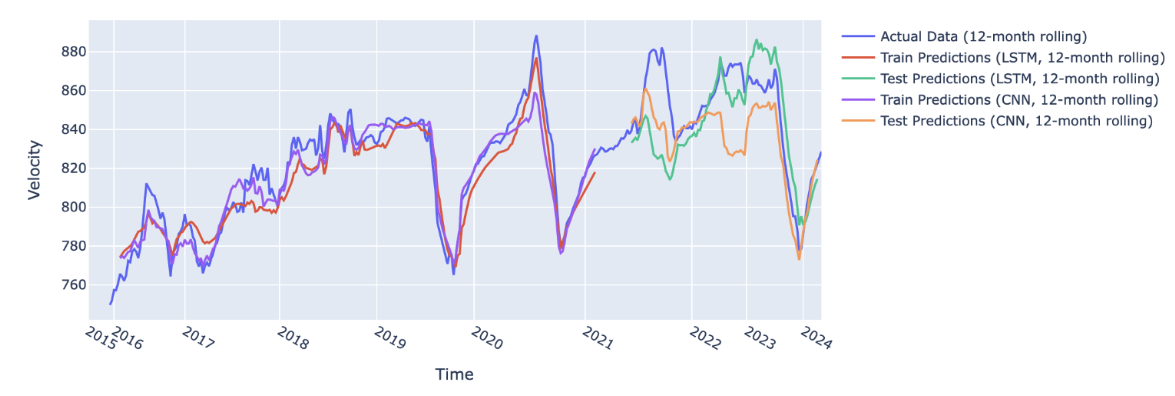 Figure The 12-month rolling average of the 6-day frequency velocity predictions from the CNN (train in purple, test in yellow) and LSTM (train in red, test in green) and the ground truth (blue).
Through the Chapter 7 lens: the audience is glaciologists and the ice-sheet modeling community — the report speaks in their quantities (velocity at named points on a named outlet glacier, seasonal amplitude) and benchmarks against their default (can the model beat the seasonal climatology?). The impact path runs toward mass-balance projections: a forecastable seasonal velocity signal constrains short-term discharge estimates for one of Greenland’s largest remaining outlet glaciers. What responsible use downstream would still need, in 7.2’s terms: uncertainty on the forecasts and evidence the per-point models transfer to points, and years, they were not tuned on — a limits statement the report is upfront about.
Add your project
Alumni: we want this gallery to grow. Open a pull request against this book’s repository adding one entry to this page, using the template below. Keep the figure under 500 kB, link a tagged version of your repository (so the link means one specific state of the work), and include the lens paragraph — it is the part future students learn from most.
## Course project: <Title> — <Name> (<Institution>, <year>)
<3-5 sentences: the question, the data (with link), the models compared,
and the headline result with its honest qualifier.>
- GitHub [repository](<url, at a version tag>)
- [Report](<url>) / [Presentation](<url>)

*Through the Chapter 7 lens:* <2-4 sentences: who the audience was and how
that shaped the deliverable; the impact path (who could act, on what
decision); and what responsible downstream use would still need.>