✗Label errors in the grading data: ~3% of test labels in ten canonical benchmarks are wrong, enough to flip model rankings.
Northcutt, C. G., Athalye, A., & Mueller, J. (2021). Pervasive label errors in test sets destabilize machine learning benchmarks. NeurIPS Datasets and Benchmarks Track.
✓Measuring the disagreement: hand experts the same seismic image and their interpretations diverge — labels are interpretations, and the spread is measurable.
Bond, C. E., Gibbs, A. D., Shipton, Z. K., & Jones, S. (2007). What do you think this is? “Conceptual uncertainty” in geoscience interpretation. GSA Today, 17(11), 4–10.
📖Why random flips are the kind case: with enough data, deep networks average away massive uniform label noise.
Rolnick, D., Veit, A., Belongie, S., & Shavit, N. (2017). Deep learning is robust to massive label noise. arXiv:1705.10694.
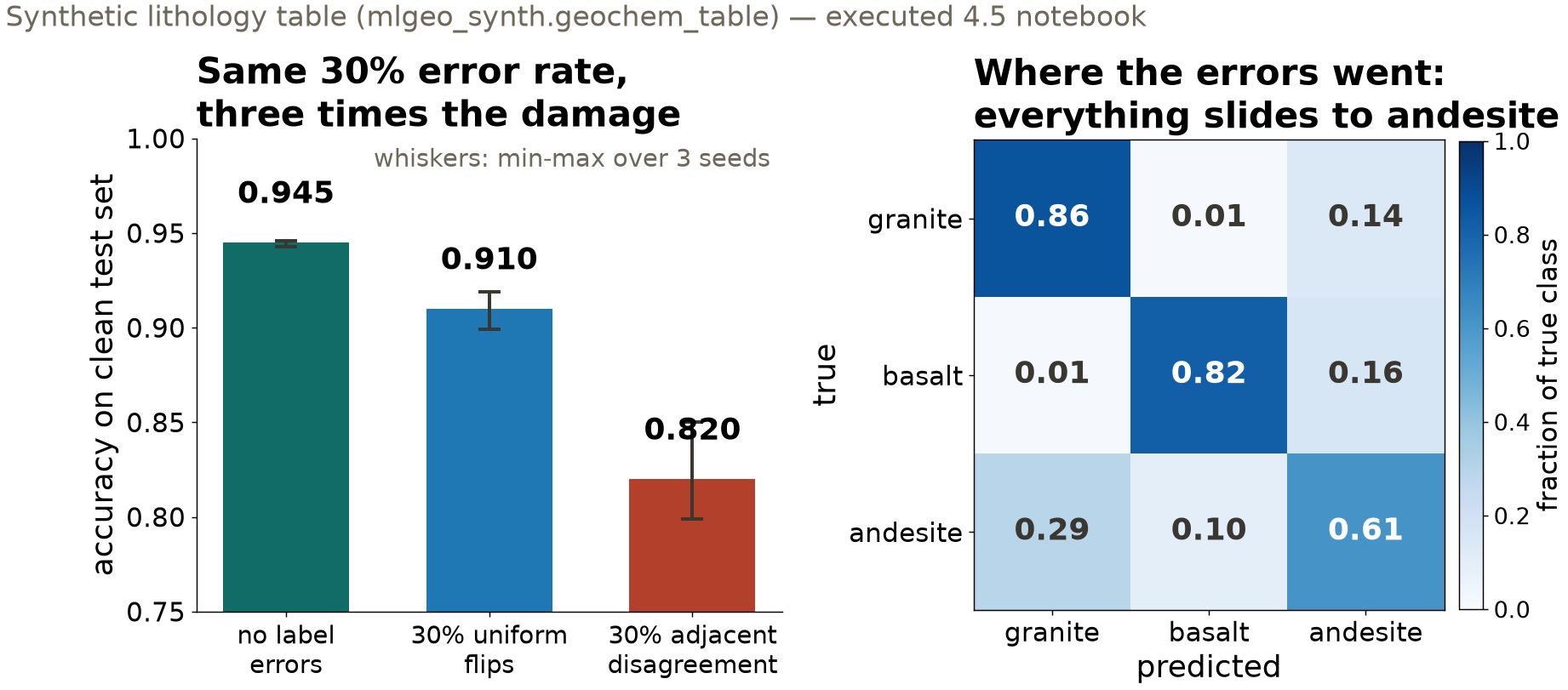
Labels are interpretations. The disagreement between experts is measurable — and it caps what any model can demonstrate.
Same error rate, different damage
30% uniform flips cost 3.5 points. 30% adjacent-class disagreement costs 12.5 — the two mappers vote coherently, and more data makes the model more confident in their shared mistake.
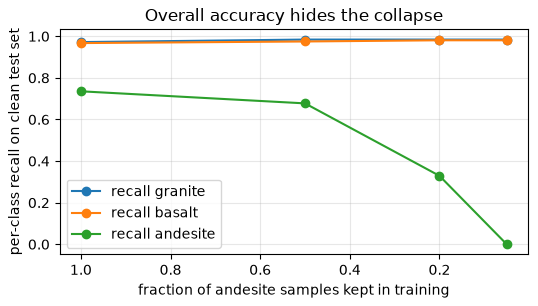
The rare class disappears quietly
Shrinking the rare class: overall accuracy drifts 0.946 → 0.881, while andesite recall collapses 0.735 → 0.000. Report per-class recall and the confusion matrix; never accuracy alone. Synthetic lithology table (mlgeo_synth).
The metadata you are throwing away
0.933 mixed lab- and field-grade data, variance ignored
0.946 same data, loss weighted by 1/σ²
All-lab-grade reference: 0.950. Heteroscedastic = the noise level varies sample to sample — and the metadata usually says by how much.
One line of loss code recovers most of what mixed data quality costs. Any column named uncertainty, std_err, or pick_weight is an invitation.
What pillar 1 buys, in one table
Defect
Signature
First fix
Uniform label noise
validation ceiling sags only on small datasets
audit labels; more data
Structured disagreement
one class annexes its neighbors; ceiling capped
measure inter-rater agreement, relabel
Class imbalance
accuracy fine, rare-class recall collapsing
class weights; check recall
Heteroscedastic noise
mixed-provenance table underperforms
weight the loss by 1/σ²
Fixing a thousand labels usually beats adding a million parameters.
Now run it yourself — open 4.5, sections 1–3
pixi run jupyter lab → mlgeo_4.5_ModelTraining.ipynb
Run the label-noise sweep in both data regimes; read the seed bands before trusting any difference
Run the two-mappers experiment and the imbalance sweep; find where the errors went in the confusion matrix
Run the heteroscedastic comparison; then the learning curve — would more data help your project?
Stop at the marked lab checkpoint (end of Section 3). Monday resumes at Section 4.
Monday: session II — uncertainty you can defend (4.5 §4–5) · HW-DL due Fri Dec 4 · classification leaderboard closed Nov 24